Amplifier or substitute? A systematic review of generative AI’s impact on higher-order cognitive skills among university students
Amplifier or substitute? A systematic review of generative AI’s impact on higher-order cognitive skills among university students
Background
As generative artificial intelligence (GenAI) becomes embedded in university learning environments, understanding its effects on students’ higher-order cognitive development has become one of the most pressing questions in educational research.
Methods
This systematic review was conducted in accordance with PRISMA 2020 guidelines, synthesizing 89 peer-reviewed journal articles published between 2024 and 2026 from Web of Science and Scopus. Narrative synthesis was employed to integrate findings across studies.
Results
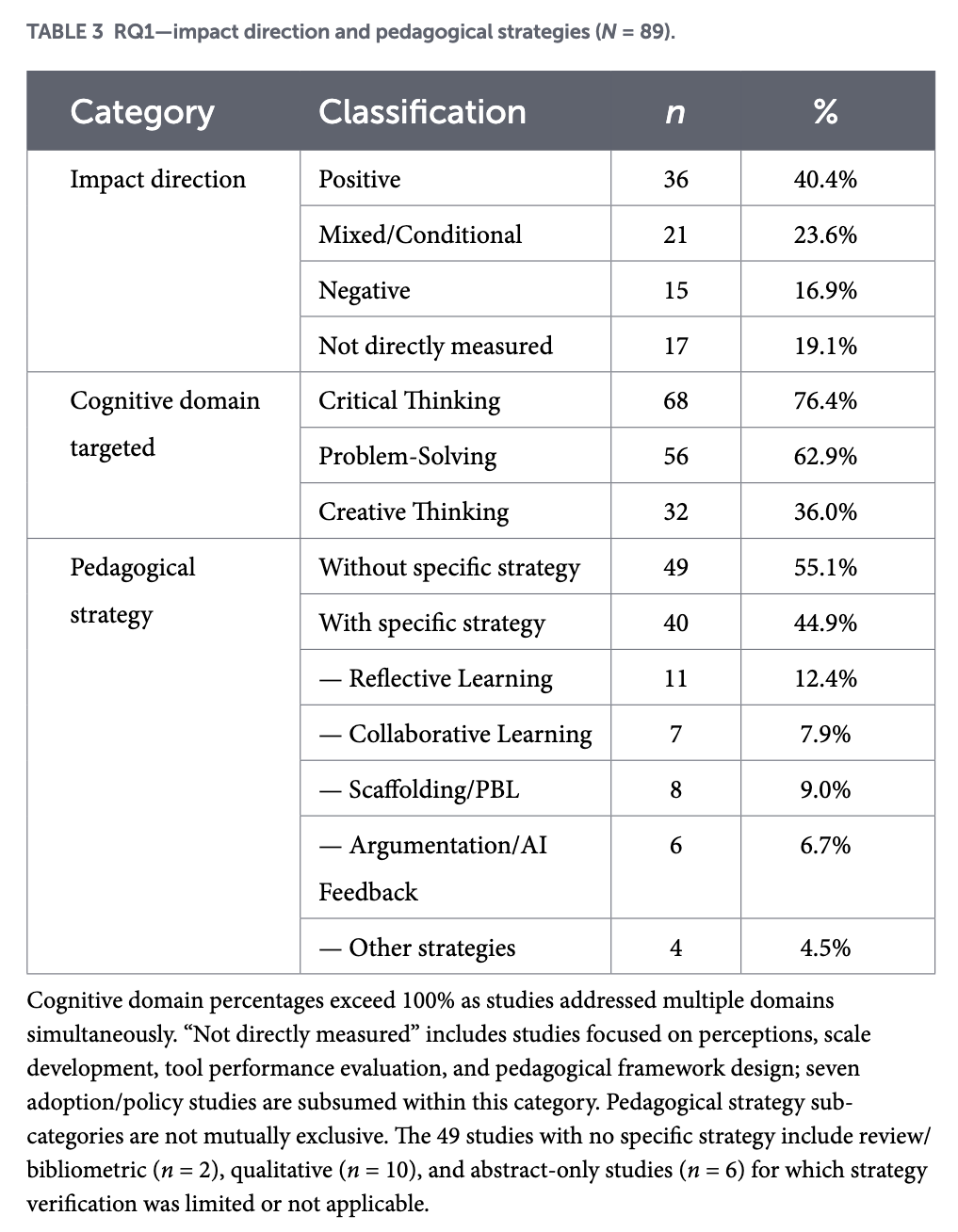
GenAI’s cognitive effects were neither uniform nor unconditional: positive outcomes were documented in 40.4% of studies and mixed or conditional effects in 23.6%. ChatGPT was the predominant tool examined (n = 61, 68.5%), and mixed-methods designs were most prevalent (42.7%). Critically, 55.1% of studies employed no specified pedagogical strategy, and explicit theoretical frameworks were identified in only 25.8% of the corpus. Over-reliance emerged as the leading cognitive risk (33.7%), followed by reduced analytical autonomy (20.2%) and cognitive offloading (18.0%).
Discussion
These findings support a Dual-Mechanism Model: GenAI functions as a cognitive amplifier under structured pedagogical conditions and as a cognitive substitute under unguided use. The evidence calls on universities to anchor GenAI integration within deliberate instructional frameworks that preserve students’ cognitive agency and foreground autonomous higher-order reasoning.
Metadata
- Authors: Alubthane, Fawzia Omer
- Year: 2026
- DOI / URL: https://www.frontiersin.org/articles/10.3389/fpsyg.2026.1863931/full
Zotero Notes
研究議題
-
生成式AI對大學生而言,是一種cognitive amplifier or cognitive substitute?
- Q1: 針對批判性思考、創意以及問題解決能力,生成式AI的影響為何?是否受到不同的教學法或是機構的教學架構調節生成式AI的影響
- 生成式AI怎麼衝擊高等教育的相關文獻中,它們使用的方法學以及理論架構為何?是否揭示了什麼使用上的認知風險?
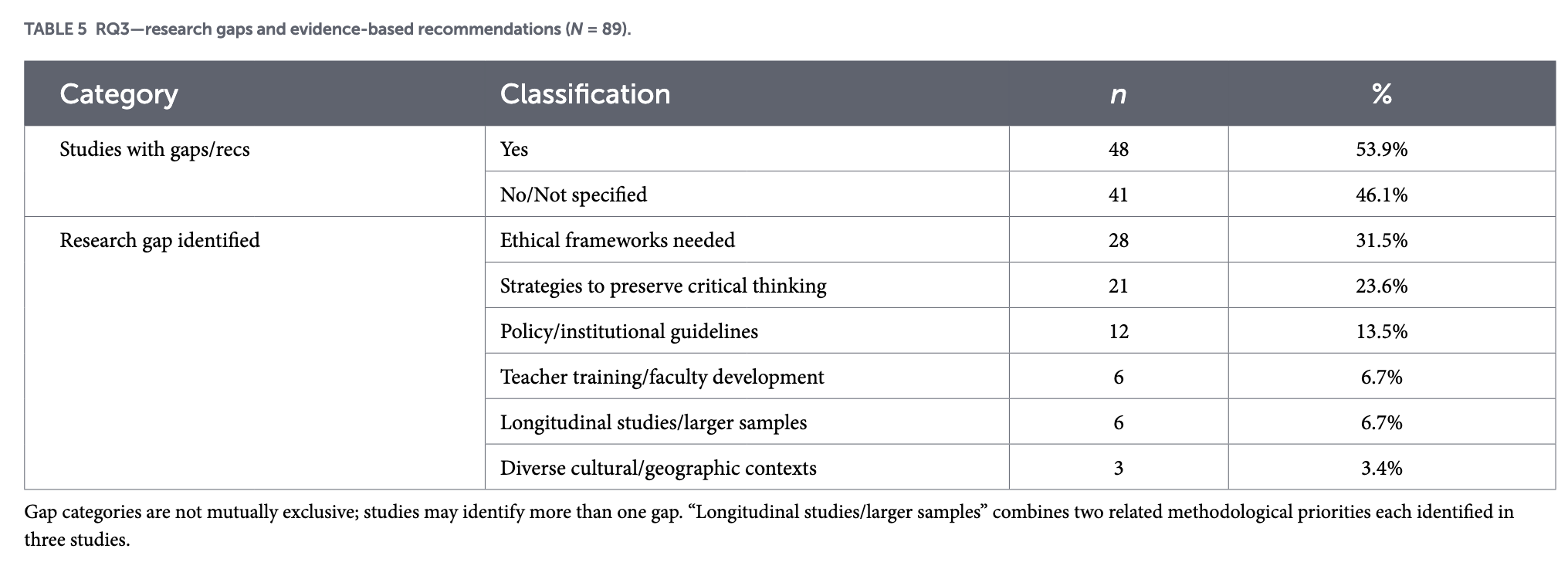
- 目前的研究結果中可能顯示有哪些research gap?對目前的教育者可以有什麼課程設計或教學方針上的建議?
主要發現
Direction and pattern of impact
-
“Positive effects were documented in 36 studies (40.4%), mixed or conditional effects in 21 (23.6%), and negative effects in 15 (16.9%).”
-
“Critical thinking was the most frequently targeted domain (n = 68, 76.4%), followed by problem-solving (n = 56, 62.9%) and creative thinking (n = 32, 36.0%).”
Pedagogical mediation
-
“Only 40 studies (44.9%) reported a specific instructional strategy, while 49 (55.1%) reported no specific strategy”
-
“The evidence consistently indicates that structured integration—through scaffolding, argumentation, or reflective cycles—produces more positive and durable cognitive outcomes than unguided use.”
Methodologies and risks
- 大部份的研究(74.2%)都沒有報告使用的theoretical frameworks
- 少部份明確標示使用的理論架構之研究中,TAM最常見(4.5%)
Research gaps and recommendations